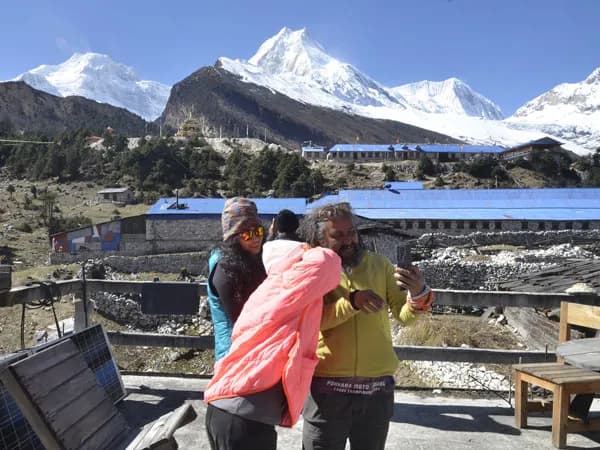
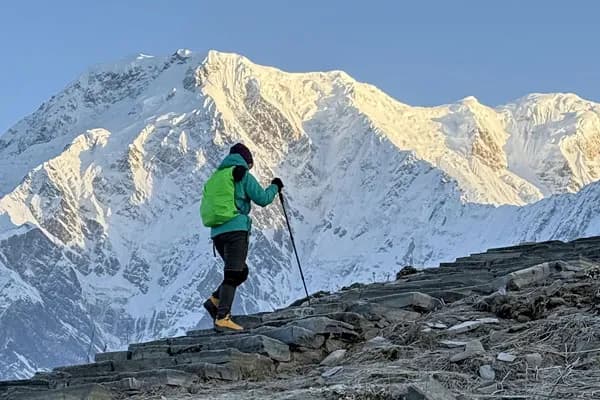
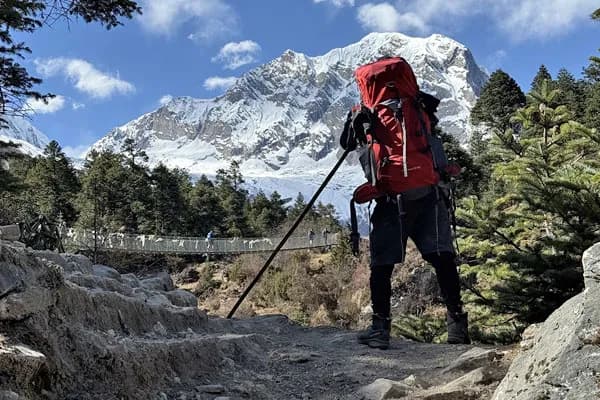
Experience the ultimate 23-day Himalayan traverse with the Manaslu and Annapurna Circuit Trek, a seamless journey connecting Nepal’s raw, restricted wilderness with its most iconic cultural heritage. Conquer the "Dual Pass Challenge" by crossing Larkya La (5,106 m) and Thorong La (5,416 m), witnessing unparalleled views of Mt. Manaslu (8,163 m) and the Annapurna Massif. This "living museum" expedition offers a profound escape from the concrete jungle, blending ancient Tibetan-influenced traditions with modern 2026 connectivity for adventurers and digital nomads alike. From lush subtropical forests to the high-altitude alpine deserts of Mustang, this all-inclusive, expert-led trek is the most comprehensive spiritual and physical odyssey available in the Himalayas today.
Manaslu and Annapurna Circuit Trek
Manaslu and Annapurna Circuit Trek: The Ultimate Himalayan Traverse. Introduction: Where the "Off-Beat" Meets the Digital Era. While the Annapurna Circuit has long been celebrated as one of the world's most beautiful trekking routes, the Manaslu Circuit is evolving. Once known strictly as a remote "off-the-beaten-path" wilderness, it is now emerging as a prime destination even for digital nomads seeking a balance of isolation and connectivity.
We are proud to introduce a combined expedition that connects these two legendary circuits in a more efficient timeframe than ever before. Historically, these treks would require nearly 40 days combined. Today, thanks to improved road connectivity in the lower regions, we have designed a 23-day odyssey that offers the most high-adventure experience available in the Himalayas.
The Paradox of Progress: Roads vs. Trails
The evolution of road networks in the Himalayas is a double-edged sword. While expanded road access serves as a vital lifeline for local communities—improving healthcare, education, and economic connectivity—it presents a challenge for trekkers seeking an authentic wilderness experience. We address this head-on by modernizing our itinerary to prioritize nature over dust. To maintain the "soul" of the journey, our route utilizes the NATT (New Annapurna Trekking Trails), which are specifically designed to bypass motorable roads in favor of scenic, traditional footpaths.
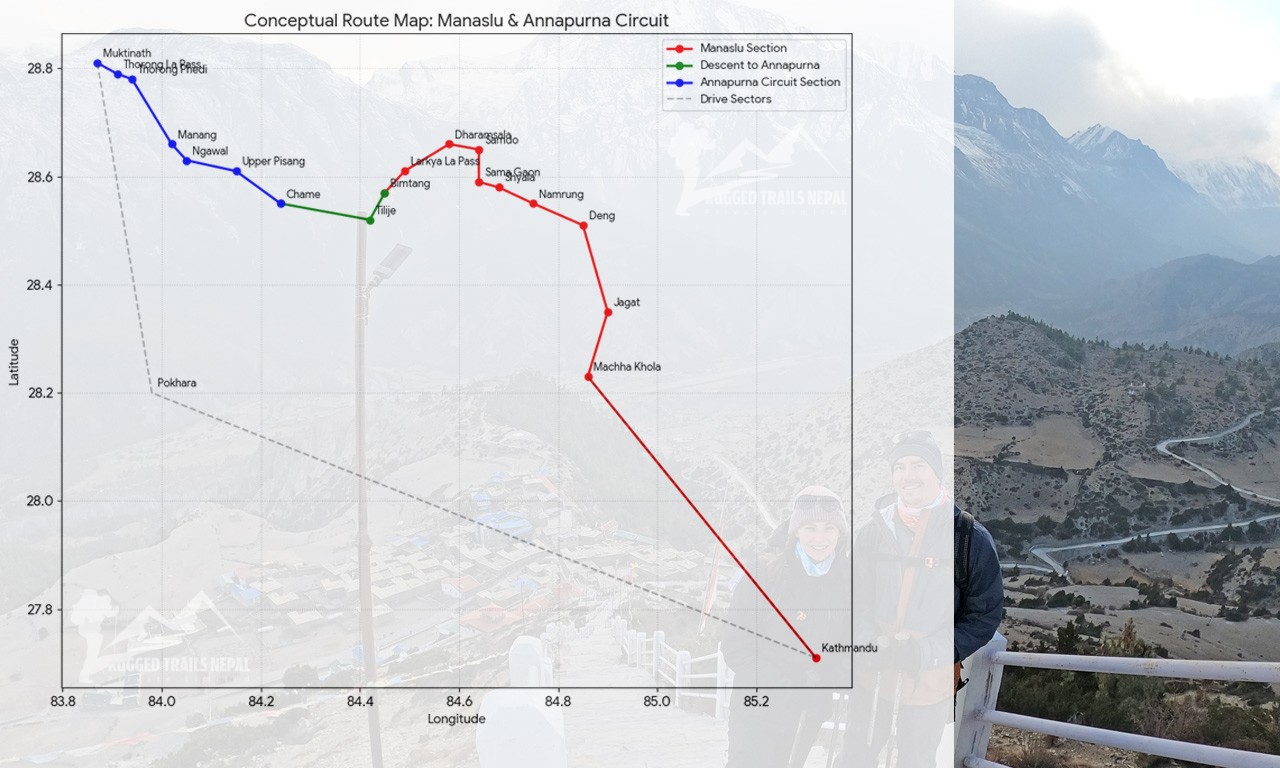
Immediately following the completion of the Manaslu section, we implement a strategic logistical shift: we utilize a private jeep from Tilche to Chame. This move allows you to escape the dusty, low-elevation road construction that has affected the classic version of the trail, saving your energy for the pristine alpine environments ahead. By skipping this transitional road section, we maximize your time in the high-value regions, ensuring you can fully immerse yourself in the Manang surroundings, ancient monasteries, and the high-altitude splendor of the Annapurna massif without the interference of modern traffic.
A Living Museum in the Age of AI
In our modern era of artificial intelligence, solar energy, and hydrogen power, finding an authentic, centuries-old lifestyle is nearly impossible. Yet, the remote corners of Nepal remain a "live museum." Here, there are no "artificial characters" or staged performances. You will witness a lifestyle that looks like a 1960s documentary: homes built of dry stone without plaster, where sunbeams pierce through small windows and cow dung is still dried on walls to be used as sustainable fuel. This is not "pretending" to be eco-friendly; this is the raw, evolutionary human struggle and success.
The Soul of the Journey: Beyond the Camera Lens
Trekking is more than capturing mountain views. Whether you come from the skyscrapers of NYC, the streets of Paris, or the hubs of Singapore, you likely carry the weight of a "concrete jungle"—a life of hurry and lost patience.
In these villages, the "lavish lifestyle" is replaced by a lavishness of the heart. The hospitality isn't a marketing tactic; it’s a deep-seated culture of Atithi Devo Bhava (The Guest is God). You will find the laughter, peace, and patience that often get lost in big cities. Travel here is a form of spiritual meditation; it provides a map of life itself.
Trek Highlights & Technical Specs
- The Dual Pass Challenge: Conquer Larkya La (5,106 m) and Thorong La (5,416 m).
- Perfect Acclimatization: By the time you reach Thorong La, your body will be fully adapted thanks to the high-altitude days spent in Manaslu (Samagaon/Manaslu Base Camp) and the side trips to Ice Lake in Manang.
- Geological Shift: Witness a dramatic transition from lush sub-tropical forests to alpine tundra and the "Alpine Desert" of Mustang.
- Iconic Vistas: Close-up encounters with Mt. Manaslu (8,163 m) and the entire Annapurna Massif.
Logistics, Food, & 2026 Connectivity
| Feature | Manaslu Section | Annapurna Section |
| Accommodation | Traditional Tea Houses. Some updated lodges (e.g., Shyala) offer private rooms with attached baths. | More developed. Some "luxury vibe" hotels with attached rooms and hot showers. |
| Food | Fresh and organic. Meat is scarce, but eggs and international dishes (Chinese/Indian/Western) are widely available. | More variety, including meat options and higher-end dining. |
| Connectivity | NTC SIM cards are the most stable. Wi-Fi is available in many villages but becomes unstable at high altitudes. | Widely available Wi-Fi and mobile data; stable enough for digital nomads. |
| Heating | Shared dining area heating. Shared western bathrooms are common. | Better infrastructure; heating is available in hubs like Manang, Jomsom, and Muktinath. |
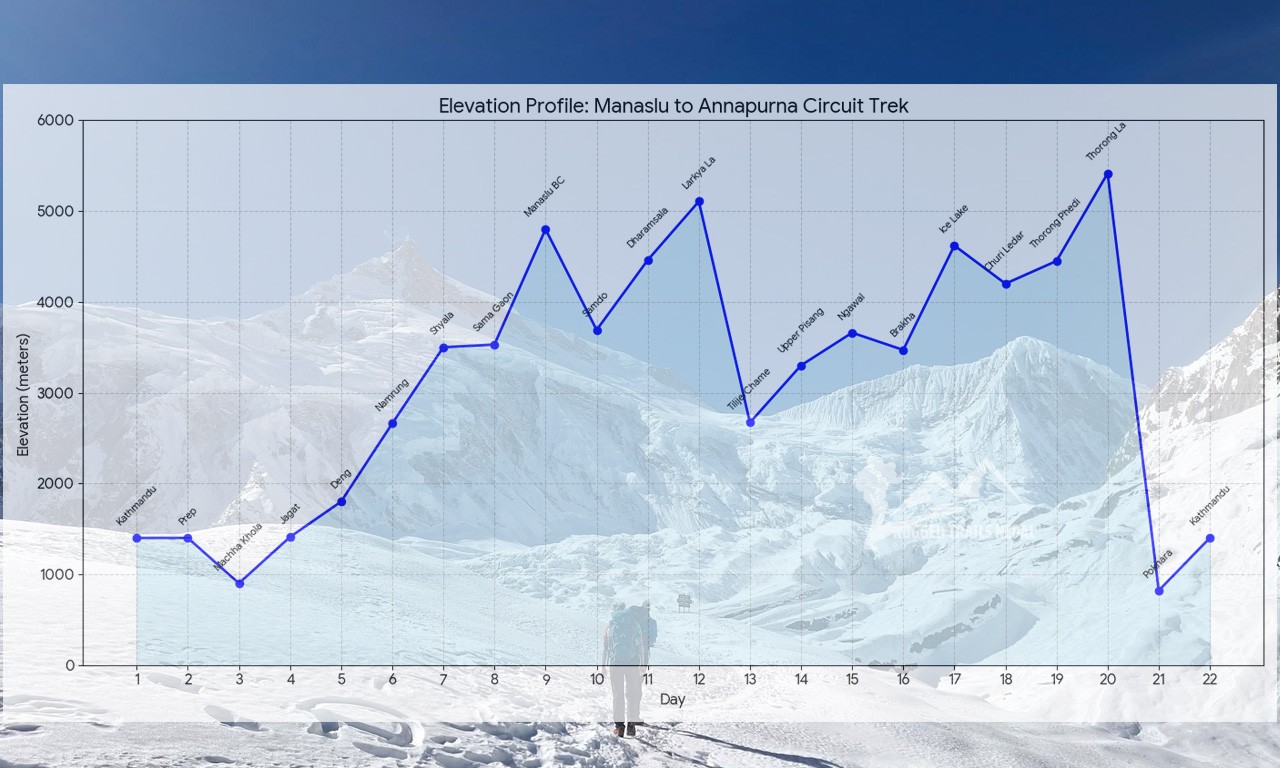
Outline Itinerary: Manaslu to Annapurna Circuit Trek (23 Days)
| Day | Destination | Max Elevation (m/ft) | Approx. Distance (km/miles) |
| 01 | Arrival in Kathmandu & Hotel Transfer | 1,400 m (4,593 ft) | - |
| 02 | Trek Preparation & Heritage Exploration | 1,400 m (4,593 ft) | - |
| 03 | Drive from Kathmandu to Machha Khola. | 900 m (2,952 ft) | 160 km / 100 mi (drive) |
| 04 | Trek Machha Khola to Jagat | 1,410 m (4,625 ft) | 22 km / 13.6 mi |
| 05 | Trek Jagat to Deng | 1,800 m (5,905 ft) | 19 km / 11.8 mi |
| 06 | Trek Deng to Namrung | 2,660 m (8,727 ft) | 17 km / 10.5 mi |
| 07 | Trek Namrung to Shyala | 3,500 m (11,482 ft) | 12 km / 7.4 mi |
| 08 | Trek from Shyala to Sama Gaon | 3,530 m (11,581 ft) | 4 km / 2.5 mi |
| 09 | Acclimatization (Manaslu Base Camp) | 4,800 m (15,748 ft) | 10 km / 6.2 mi (Loop) |
| 10 | Trek from Sama Gaon to Samdo | 3,690 m (12,106 ft) | 8 km / 5 mi |
| 11 | Trek Samdo to Dharamsala | 4,460 m (14,632 ft) | 7 km / 4.3 mi |
| 12 | Larkya La Pass to Bimtang | 5,106 m (16,752 ft) | 24 km / 14.9 mi |
| 13 | Trek to Tilije and then Jeep Drive to Chame. | 2,670 m (8,760 ft) | 15 km / 21 mi |
| 14 | Trek Chame to Upper Pisang (NATT) | 3,300 m (10,826 ft) | 15 km / 9.3 mi |
| 15 | Trek Upper Pisang to Ngawal | 3,660 m (12,007 ft) | 10 km / 6.2 mi |
| 16 | Trek Ngawal to Brakha via Julu | 3,470 m (11,384 ft) | 8 km / 5 mi |
| 17 | Ice Lake Hike & Trek to Manang | 4,620 m (15,157 ft) | 12 km / 7.5 mi |
| 18 | Trek Manang to Churi Ledar | 4,200 m (13,779 ft) | 10 km / 6.2 mi |
| 19 | Trek Churi Ledar to Thorong Phedi | 4,450 m (14,599 ft) | 5 km / 3.1 mi |
| 20 | Thorong La Pass to Muktinath | 5,416 m (17,769 ft) | 16 km / 10 mi |
| 21 | Drive Muktinath to Pokhara | 820 m (2,690 ft) | 175 km / 108 mi (drive) |
| 22 | Drive from Pokhara to Kathmandu. | 1,400 m (4,593 ft) | 200 km / 124 mi (drive) |
| 23 | Final Departure | - | - |
Strategic Seasonal Timing and Weather Considerations
Choosing the right season is the first step toward a successful Manaslu and Annapurna Circuit traverse. For the most iconic experience, we recommend focusing on the spring (March to May) and autumn (September to November) windows. Spring trekkers are treated to vibrant rhododendron blooms and stable morning skies, while autumn offers the most crisp, crystal-clear mountain visibility in the Himalayas. To prioritize your safety, we avoid scheduling this trek during the monsoon and winter months, as these seasons bring significant risks of landslides and heavy snow blocking the high passes of Larkya La and Thorong La.
Physical Training and Altitude Management Strategies
The combined Manaslu and Annapurna trek is a strenuous undertaking that requires dedicated physical preparation. Prospective trekkers should focus on building cardiovascular endurance and significant leg strength to remain comfortable walking 6 to 8 hours daily over consecutive weeks. Beyond physical fitness, the golden rule of high-altitude trekking is "the slow rule." Because altitude is the primary challenge, we emphasize a steady, rhythmic pace. Monitoring your oxygen saturation is more critical than your speed, ensuring your body acclimates properly to the thinning air of the high Himalayas.
Essential Gear and Comprehensive Travel Insurance
High-altitude logistics require specialized equipment and protection. A professional-grade -15 Crated sleeping bag is an absolute necessity, as temperatures in high-altitude lodges like Samdo or Thorong Phedi can drop drastically overnight. For those who do not wish to bring their own, high-quality and affordable trekking gear is readily available for rent or purchase in Thamel, Kathmandu. Furthermore, comprehensive travel insurance is a mandatory requirement for this journey. It is vital to ensure your policy specifically covers emergency helicopter evacuation and medical expenses up to 5,500 m, providing peace of mind as you navigate the remote reaches of the Manaslu and Annapurna regions.
Trek Permit Management and Professional Mountain Leadership
Our package handles the entire process of trekking permits. We secure all necessary documentation, including the Manaslu Restricted Area Permit (RAP), the Manaslu Conservation Area Project (MCAP), and the Annapurna Conservation Area Project (ACAP), along with all required local municipality taxes. To ensure a safe and insightful journey, your expedition is led by a government-licensed professional mountain guide. Our leaders are expertly trained in first aid and carry essential diagnostic tools like oximeters to monitor your health daily, ensuring a secure and culturally immersive trekking experience.
Your Trek, Your Way: Customization & Quick Chat
While this 23-day itinerary is our Standard Professional Plan—optimized for the best views and safest acclimatization—we understand that every adventurer has unique needs.
This is our standard trek itinerary, but if you have a tight time limit or wish to extend your journey, please reach out for a quick chat. We are happy to customize the trip for you!
Whether you want to add a side trip to Tilicho Lake, explore the Tsum Valley, or need a "fast-track" version of this route, our team is ready to build your dream Himalayan odyssey.
What You’ll Explore
Cost Details
What’s Included
- Hotel accommodation in Kathmandu and Pokhara with breakfast.
- Airport pick-up upon arrival and drop-off at the airport.
- Kathmandu City Tour with Culture Expert Guide.
- Welcome dinner in Kathmandu.
- Comfortable private and public transport as per the itinerary, including:
- Full Board (breakfast, lunch, and dinner) in Trekking
- Accommodation during the trek (local lodge).
- Government-registered English-speaking local expert guides and porters.
- Annapurna and Manaslu Conservation Park fees.
- Manaslu Trek permits & government taxes.
- Equipment and clothing for porters and staff.
- Insurance for all staff and porters.
- Ground transportation to and from the starting and ending points of the trek
- First Aid Kit, oximeter
- Manaslu to Annapurna Circuit Trekking Map.
- Salary, allowances, and expenses for all staff.
- Duffel bags.
What’s Excluded
- Nepal visa: Multiple Entry (30 days): USD 50
- Entrance fees while visiting Kathmandu heritage sites (approx. 20 USD)
- Personal gear and clothing (available on hire)
- Tips for guides and porters.
- Personal insurance and medical evacuation in case of emergency.
- Services other than those mentioned above
- Expenses incurred due to accidents, landslides, strikes, political unrest, etc.
- Hot shower, battery charge (during the trek), etc.
- Items of a personal nature such as alcoholic drinks, cold drinks, laundry, and mineral water
Dates & Availability
Trip Departures: Your Schedule, Our Expertise
Unlike standard fixed-date tours, our Manaslu and Annapurna Circuit expeditions are primarily Private Group Based. We prioritize a service-oriented approach that caters specifically to your pace, preferences, and timeline.
- Your Schedule, Your Rules: If you have your own group of 3, 5, or 10+ trekkers, we will organize the departure according to your preferred start date.
- Open Group Slots: If you are a solo traveler or a small duo and wish to have others join your journey to share costs and experiences, let us know! We can open "Join-In" slots for your specific dates.
- Exclusive Group Discounts: Traveling with a larger crew? We offer attractive group discount packages for teams of 5 or more.
Essential Information
Essential Traveler Info: Manaslu to Annapurna Circuit 2026
1. Restricted Area Permits & Group Formation
The Manaslu region remains a pristine, restricted conservation zone. Per Nepal’s 2026 immigration rules, a minimum of two trekkers and a licensed guide are mandatory to issue the Restricted Area Permit (RAP).
-
Solo Travelers: If you are traveling alone, don't worry. We specialize in "Permit Joining." We will pair your permit application with another trekker to meet the legal requirement, even if you prefer to walk at your own pace with your private guide.
2. Safety & Empowerment for Female Trekkers
We are committed to making the Himalayas accessible and safe for everyone. We have a zero-tolerance policy for harassment and take immense pride in hosting solo female travelers.
-
Custom Support: We can provide female trekking guides upon request (subject to availability) to ensure you feel 100% comfortable and supported throughout the 23-day journey.
3. Strategic Logistics: Tilije to Chame Jeep Transfer
Modern trekking in 2026 is about "Hiking Smart." To preserve the quality of your experience, we include a private jeep transfer from Tilije to Chame (approx. 21 km).
-
Why? This section of the classic Annapurna route now shares space with a motorable road. By taking the jeep, you avoid two days of walking in the dust and transition directly into the superior NATT (New Annapurna Trekking Trails) starting from Chame.
4. Fully Digital Permit Processing & Simplified Requirements
As of 2026, the permit process for the Manaslu and Annapurna Circuit has moved to a high-efficiency digital platform. You no longer need to surrender your physical passport or wait hours at a government office.
- The Process: To secure your Manaslu Restricted Area Permit (RAP), as well as your MCAP and ACAP permits, our team handles everything online. We simply require a high-quality digital scan of your Passport and a copy of your Nepal Visa (which can be sent as soon as you clear immigration at the airport).
- Approval Timing: While the application is digital, the Department of Immigration only reviews and approves RAP permits during official working days (Sunday to Friday). For this reason, we recommend providing your visa copy as early as possible to ensure your permits are ready for your scheduled departure.
- No Physical Photos Needed: In line with the digital shift, physical passport-sized photos are no longer a requirement for the RAP. A high-resolution digital portrait is all we need to upload into the government system to generate your electronic permits.
5. Budgeting: Cash is King in the Mountains
While Kathmandu and Pokhara are card-friendly, the trails are not. There are no ATMs between Machha Khola and Manang.
- Recommended Budget: Carry NPR 3,000–4,000 per day ($25–$35 USD) for personal expenses.
- What to pay for: Bottled water (NPR 100–400), hot showers (NPR 100–600), device charging (NPR 100–500), and tips for your hardworking crew.
6. Health & "Pre-Trek" Hygiene
Your digestive health is your most important piece of gear.
- Street Food: While tempting, we advise avoiding street food in Kathmandu for at least 3 days before your trek. Stick to reputable Thamel restaurants like OR2K or Northfield Cafe to ensure your stomach is 100% ready for the high altitude.
- Water: Never drink tap water. Use a LifeStraw, UV purifier, or chlorine tablets.
Booking & Payment Procedures
Step 1: Secure Your 2026/2027 Dates
To confirm your expedition, we require a 20% non-refundable deposit. This allows us to book your internal logistics, hotels, and flight-sensitive timings.
-
Payment Methods: Secure Online Credit Card Link (4% bank fee applies) or SWIFT/Wire Transfer.
Step 2: Required Documentation
Email us clear copies of:
- Passport Bio-Page (valid for 6+ months).
- Digital Passport Photo (high-resolution).
- Travel Insurance Policy (must explicitly cover helicopter evacuation up to 6,000 m).
Step 3: Final Balance
The remaining 80% balance is due upon your arrival in Kathmandu. We accept cash (USD, EUR, GBP, NPR) or credit cards (a 4% processing fee applies).

Client Reviews
Outstanding experience!
We were in December and January 2017/18 in Nepal on the road and have received an all-inclusive package for 4 weeks. Our guides for Kathmandu and for trekking were phenomenal, the organization excellent. We felt...
Chapter by Chapter, Mile by Mile

Similar Treks