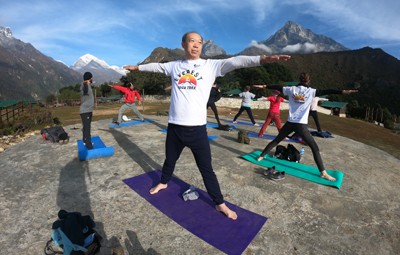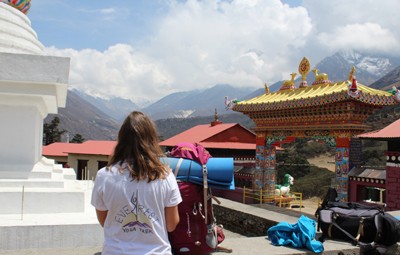
"Most people come to this trek chasing an experience. What they find is something quieter — a better understanding of their own limits, patience, and gratitude. The Rugged Trails Everest Base Camp Yoga Trek takes you through Gokyo Lakes, Cho La Pass, and all the way to Base Camp over 18 days. Here is exactly what to expect, day by day."
Everest Base Camp Yoga Trek Day By Day
Table of Contents
Everest Base Camp Yoga Trek: What to Expect Day by Day (2026 and 2027 Guide)
Thousands of people trek to Everest Base Camp every year. A much smaller group does it with a yoga mat strapped to their pack, a certified instructor at their side, and a morning pranayama session at 5,000 metres before the trail even begins. That is exactly what the Rugged Trails Nepal Everest Base Camp Yoga Trek offers — and it is the only 18-day yoga trekking itinerary in the Everest region that goes via Gokyo Lakes and crosses the dramatic Cho La Pass. We created it. We run it twice a year. And we are going to walk you through every single day of it here.
Whether you are a seasoned yogi wondering if your practice survives altitude, or a trekker who has never unrolled a mat but is curious about what adding yoga would actually change about the experience — this guide is written for you. If you have ever dreamed of trekking to Everest Base Camp while also experiencing the turquoise magic of the Gokyo Lakes, this is the one package that does both. Most EBC treks make you choose one or the other. This itinerary combines them into a single 18-day journey — Gokyo Lakes, Gokyo Ri, Cho La Pass, and Everest Base Camp, all woven together with daily yoga. If that has been your dream, you have found exactly the right trek.
A Honest Word Before We Begin
Let's be straight with you about something.
You are not going to come back from this trek as a yoga master. You are not going to reach enlightenment at 5,500 metres. Nobody is going to hand you a certificate of spiritual transformation at the top of Kala Patthar. But here is what we believe — and what we have watched happen with our own eyes, year after year, on this mountain:
You will be revived.
The Himalayas have always been a place of healing. Not the Instagram kind, not the wellness-retreat-with-a-smoothie kind — the real kind. The slow, unglamorous, deeply necessary kind that happens when you remove yourself from the noise long enough to hear yourself think again. We are all living through chaotic times. The news cycle alone is enough to quietly erode a person. Add to that the pressure to keep up with social media trends, the comparisons, the addictions, the stress that has become so normal we have stopped recognising it as stress — and it becomes clear that most of us are carrying far more than we should be.
On this trek, you will stand on a viewpoint at dawn with the world's highest peaks around you and nowhere to be except exactly where you are. And something will loosen. It always does. You will understand your own limits — not as failures, but as honest information about who you are. You will discover a patience in yourself you forgot you had. You will feel gratitude, real gratitude, for things you stopped noticing: your body working, air in your lungs, the simple warmth of a cup of tea after a long day.
That is what the Himalayas offer. Not answers. Not enlightenment. Just a rare, precious chance to understand yourself a little more clearly — and return home a little more whole. That is why we run this trek. And that is why, if something in you is pulling toward it, you should probably listen.
What Makes the EBC Yoga Trek Different from a Standard EBC Trek?
The standard Everest Base Camp trek follows a well-worn route: Lukla, Phakding, Namche, Tengboche, Dingboche, Lobuche, Gorak Shep, Base Camp, turnaround. The Rugged Trails EBC Yoga Trek does something different. It takes the Gokyo Valley route, which means you walk through five sacred high-altitude lakes, summit Gokyo Ri (5,360 m) for arguably the finest panoramic view in the entire Khumbu region, and then cross the Cho La Pass (5,420 m) — a high glacier crossing that the classic route never touches.
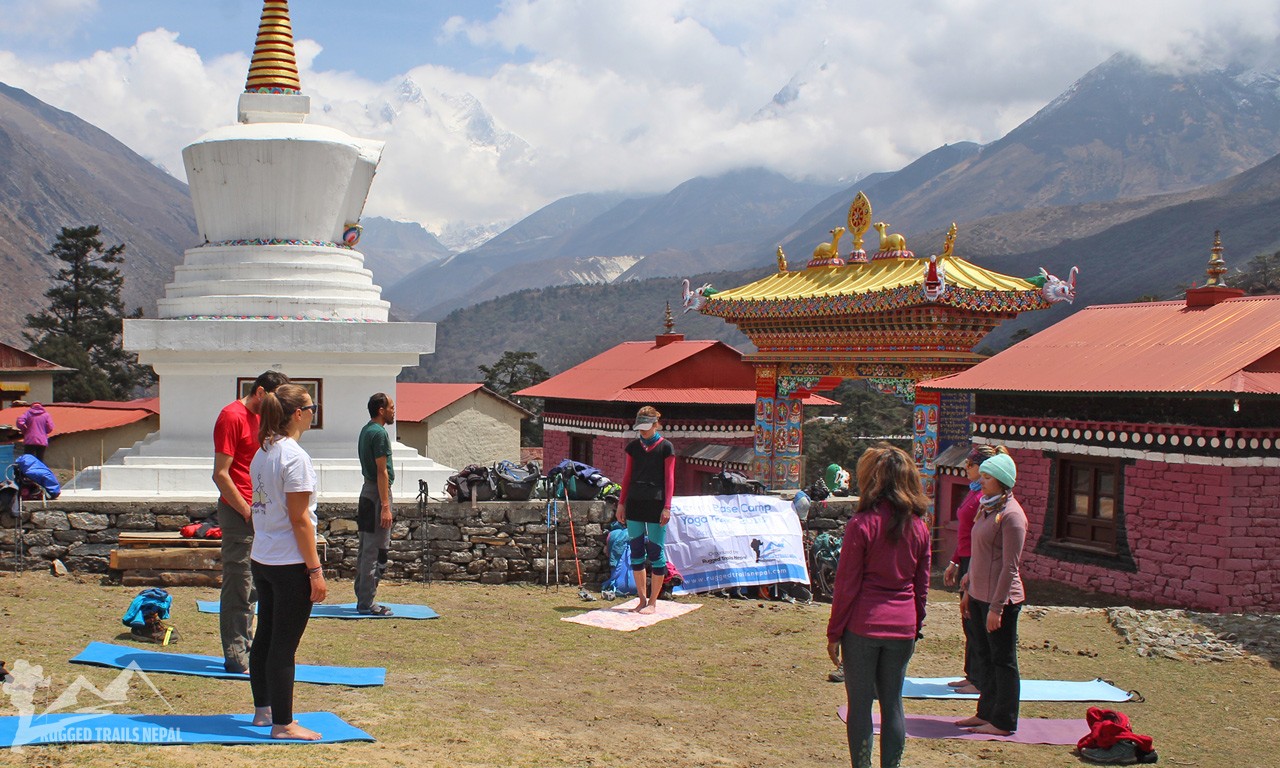
On top of that, every day of the 18-day journey begins and ends with yoga. Morning sessions focus on pranayama (breathwork), meditation, and asana to set intention and warm the body. Evening sessions use restorative poses and guided meditation to process the day, reduce muscle soreness, and prepare for sleep at altitude. The trek was featured by Red Bull as one of the nine coolest yoga spots in the world. Rugged Trails Nepal is the original creator of this itinerary.
The Team: Why Rugged Trails Is Different from Other Operators
This is worth saying clearly, because it is the detail that most people overlook when comparing yoga trek packages. Most operators running a so-called "yoga trek" to Everest Base Camp simply hire a yoga guide — someone who can lead a few poses — and add porters to carry the bags. That is it.
One person wearing two hats, responsible for both the mountain and the mat.
Rugged Trails Nepal runs this differently. Every departure includes a dedicated four-person professional team:
- 1. Certified international yoga instructor — a qualified teacher whose only job is your yoga practice. Not a guide who also does yoga. A yoga professional who travels with the group from day one to the last session at Kala Patthar.
- 2. Licensed government-registered Sherpa guide — an experienced, English-speaking mountain professional whose full focus is navigation, safety, acclimatisation monitoring, and getting the group up and back safely.
- 3. Assistant Sherpa — supporting the lead guide, liaising with teahouses, carrying emergency equipment, and ensuring nothing slips through the cracks on a long high-altitude itinerary.
- 4. Porters — carrying your gear so you can walk with a light daypack and give your body the best chance at altitude.
When you book a yoga trek elsewhere, ask them directly: who leads the yoga? Who leads the trekking? Are they the same person? The answer will tell you everything about what the experience will actually be like on the mountain.
Quick Facts Before We Begin
| Detail | Info |
|---|---|
| Duration | 18 days |
| Max altitude | Kala Patthar — 5,545 m (18,192 ft) |
| Difficulty | Moderate to challenging |
| Price from | $2,199 per person (group discount: $1,875 for 2 people) |
| Group size | Minimum 7, maximum 13 |
| Age range | 15 to 60 years |
| Yoga experience needed | None — all levels welcome |
| Departures 2026, 2027 | April 4–21 · October 7–24 |
| Yoga style | Vinyasa and Hatha with breathwork and meditation |
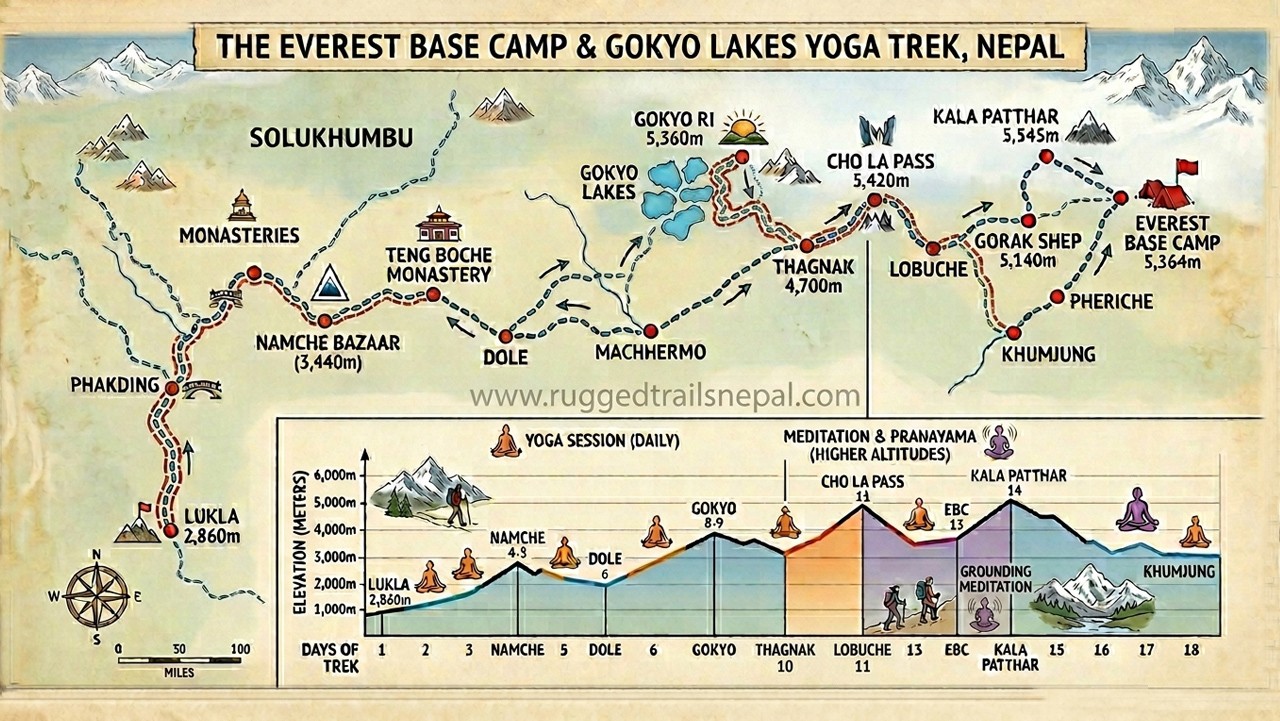
Day-by-Day Breakdown: The Full 18-Day Everest Base Camp Yoga Trek
Day 1 — Arrival in Kathmandu (1,300 m)
Your Rugged Trails Nepal representative meets you at Tribhuvan International Airport and transfers you to your hotel in Thamel. The evening begins with a welcome dinner at a traditional Nepali restaurant — authentic cuisine, cultural performance, and the first chance to meet your group.
This night is about settling in, adjusting to the time zone, and absorbing that particular energy Kathmandu always carries. Rest well. Tomorrow begins early.
Overnight: Hotel in Kathmandu | Meals: Dinner
Day 2 — Kathmandu: Heritage Sightseeing and First Yoga Session (1,300 m)
The trek has not yet started, but the yoga has. Your morning begins with an asana session at the hotel before a filling breakfast.
The day's sightseeing takes you to three UNESCO World Heritage Sites: Swayambhunath Temple (the Monkey Temple), where your guide leads a warming yoga practice on the hilltop terrace with the city spread below; Pashupatinath, Nepal's most sacred Hindu temple on the banks of the Bagmati River; and Boudhanath Stupa, one of the largest Buddhist stupas in the world. In the afternoon, your guide helps you pick up any remaining trekking gear in Thamel. Evening includes a briefing for the days ahead — permits, trail conditions, packing tips, and altitude expectations.
Overnight: Hotel in Kathmandu | Meals: Breakfast
Day 3 — Fly Kathmandu to Lukla, Trek to Phakding (2,610 m)
An early wake-up — your packed breakfast is ready before dawn. The 35-minute flight to Lukla is one of the most spectacular short flights in the world, threading between cloud and ridgeline until the Tenzing-Hillary Airport runway appears, steep and short, cut into the hillside. At Lukla your full crew joins: Sherpa guide, assistant Sherpas, porters, and your certified yoga instructor. After introductions and a trail briefing, you walk a gentle path downhill through Chaurikharkha village toward Phakding, passing the sacred peak of Khumbila and a riverside monastery.
Since the early flight leaves no time for morning yoga, today's session happens in the evening at the teahouse.
Trek: 4 hours / 8 km | Overnight: Teahouse, Phakding | Meals: Breakfast, Lunch, Dinner
Day 4 — Phakding to Namche Bazaar (3,440 m)
This is the day everyone warns you about — and rightly so. The climb into Namche Bazaar is long, steep, and relentless in its final push. But the trail through pine forest, along the roaring Dudh Koshi River, past suspension bridges draped in prayer flags, and through the gateway of Sagarmatha National Park is as beautiful as any in Nepal.
An hour before Namche, if the sky is clear, Everest appears for the first time above the ridge — just a glimpse, but enough to stop you in your tracks. Namche itself is the heartbeat of the Khumbu: bakeries, gear shops, wifi, a Saturday market, and one of the finest views you will see from a town. Your morning yoga session happens at the teahouse before departure; the achievement of arriving in Namche deserves its own quiet celebration.
Trek: 5–6 hours / 10–12 km | Overnight: Teahouse, Namche Bazaar | Meals: Breakfast, Lunch, Dinner
Day 5 — Acclimatisation Day in Namche Bazaar (day hike to 3,700 m)
Acclimatisation does not mean rest. The rule at altitude is: climb high, sleep low. So after morning yoga with the mountains as your backdrop, the group hikes up to the Everest View Hotel — perched at 3,880 m with a panorama that takes in Everest, Lhotse, Nuptse, Ama Dablam, and Thamserku simultaneously. Your yoga instructor leads a mid-morning practice at this viewpoint. Few yoga experiences in the world compare to a sun salutation facing the world's highest peak. In the afternoon, the group descends back to Namche for lunch, free time, and optional monastery exploration for an evening sit.
Trek: 3 hours / 3 km round trip | Overnight: Teahouse, Namche Bazaar | Meals: Breakfast, Lunch, Dinner
Day 6 — Namche to Phortse Thanga (3,950 m)
Leaving the comforts of Namche, the trail climbs steeply through rhododendron forest — blazing red and pink in the April departure season. Juniper and large conifers thicken as altitude increases. The group passes through yak grazing grounds (kharkas) and visits Mohang, the birthplace of a re-incarnated lama of Rongbuk Monastery. Views of Khumbila and Tawache peak accompany most of the day's walking. Morning and evening yoga both happen today as the routine deepens.
Trek: 6 hours / 10 km | Overnight: Teahouse, Phortse Thanga | Meals: Breakfast, Lunch, Dinner
Day 7 — Phortse Thanga to Machhermo (4,470 m)
The trail climbs from Phortse onto a long ridge with sweeping views down the Gokyo valley and up toward the white bulk of Cho Oyu (8,188 m). It descends to a river crossing before climbing steeply to the terminal moraine of the Ngozumpa Glacier — the longest glacier in Nepal. Rhododendron forest and a roadside waterfall mark the middle of the day before the trail opens out into the bare, wide valley approaching Machhermo. You are well above 4,000 m now; breathwork in the morning yoga session begins to feel essential rather than optional.
Trek: 5 hours / 8 km | Overnight: Teahouse, Machhermo | Meals: Breakfast, Lunch, Dinner
Day 8 — Machhermo to Gokyo (4,750 m)
The trail passes through Pangka and descends briefly to the riverbank before climbing onto the terminal moraine of the Ngozumpa Glacier. The first of the five sacred Gokyo Lakes appears — turquoise, still, impossibly vivid against grey rock and white sky.
You pass the second lake, where the trail toward Cho La branches off (you will return this way later), and finally arrive at the third lake: Dudh Pokhari, on whose eastern shore the village of Gokyo sits. Cho Oyu and Gyachung Kang are reflected in the emerald water. This is one of the most beautiful camp locations in Nepal. The evening yoga and meditation session here, with the glacier and the lake and the silence, is something trekkers consistently describe as one of the most moving moments of the entire journey.
Trek: 5 hours / 7 km | Overnight: Teahouse, Gokyo | Meals: Breakfast, Lunch, Dinner
Day 9 — Gokyo Acclimatisation: Hike to Gokyo Ri (5,360 m)
After morning yoga and breakfast, the group climbs Gokyo Ri — a steep, rocky ascent of around 600 vertical metres that rewards with one of the most comprehensive Himalayan panoramas available without technical climbing. From the summit: Cho Oyu, Everest, Lhotse, Nuptse, Makalu, and the full sweep of the Ngozumpa Glacier — the largest glacier in the Himalayas — spread below.
Your yoga instructor leads a short practice at the top. This is not a full session — just a few poses and breathwork as the wind allows — but standing in a mountain pose at 5,360 m with Everest directly ahead is a moment that does not require explanation. Afternoon is free at Gokyo: rest, photography, journaling, or a walk to the fourth or fifth lakes.
Trek: 4 hours / 3 km round trip | Overnight: Teahouse, Gokyo | Meals: Breakfast, Lunch, Dinner
Day 10 — Gokyo to Thagnak (4,750 m)
A shorter day by design. The trail crosses the Ngozumpa Glacier — an otherworldly walk across the moraine and ice — and arrives at the small settlement of Thagnak. Yoga and rest in the afternoon are deliberate preparation for the hardest day of the trek that follows.
Trek: 4 hours / 3.7 km | Overnight: Teahouse, Thagnak | Meals: Breakfast, Lunch, Dinner
Day 11 — Cho La Pass Crossing to Dzongla (4,830 m)
The Cho La Pass at 5,420 m is the highest point of the walking route and the most technically demanding section of the entire trek. The approach from Thagnak climbs through a rocky ravine to the base of the pass, where the trail crosses a glacier — crampons may be required depending on conditions, and your guides will make that call. The top of the pass is decorated with prayer flags and offers a 360-degree panorama at the edge of the world. The descent to Dzongla is steep, rocky, and rewarding. From Dzongla, Ama Dablam, Cholatse, and Lobuche peak fill the skyline. This day runs 8 hours or more. Morning yoga is short and focused on breathwork. Evening is rest, warm food, and gratitude.
Trek: 8 hours / 15 km | Overnight: Teahouse, Dzongla | Meals: Breakfast, Lunch, Dinner
Day 12 — Dzongla to Lobuche (4,940 m)
A short, easy day after the Cho La crossing. The trail descends gently to Lobuche, with commanding views back toward the pass and forward toward the Khumbu valley. The pace is deliberately slow — time to process, recover, and let the body absorb the altitude gain.
Trek: 3 hours / 6.5 km | Overnight: Teahouse, Lobuche | Meals: Breakfast, Lunch, Dinner
Day 13 — Lobuche to Gorak Shep to Everest Base Camp (5,364 m) and Back to Gorak Shep (5,164 m)
The day everyone came for.
The morning session is meditation and pranayama — your instructor focuses on slow, deliberate breathing in preparation for the thin air ahead. The trail to Gorak Shep, the last settlement before Base Camp, is rocky and relentless, with Everest, Nuptse, and Pumori as constant companions. After dropping bags at the Gorak Shep teahouse, the group continues the final 3.5 km to Everest Base Camp at 5,364 m. In spring, the Base Camp is populated with expedition teams and their coloured tents — a strange, purposeful city on the glacier. Your guides know the terrain well and will navigate you safely to the memorial cairns and viewpoints. The return to Gorak Shep takes 2 hours. By this point in an 18-day trek, there is a quietness to how people walk — full, satisfied, slightly breathless, deeply present.
Trek: 7 hours / 13 km total | Overnight: Teahouse, Gorak Shep | Meals: Breakfast, Lunch, Dinner
Day 14 — Kala Patthar Sunrise (5,545 m) and Trek to Pheriche (4,371 m)
The alarm goes at 4 am. The temperature outside is between -10°C and -14°C. Nobody complains.
Kala Patthar is a black rocky peak above Gorak Shep that offers the highest and closest viewpoint of Everest accessible without a climbing permit. The summit sits at 5,545 m — the highest point of the entire trek. Sunrise from here, with Everest's South Face lit in the first light and the entire Khumbu glacier below you, is the kind of experience that reorders your understanding of scale. Your yoga instructor leads a practice at the summit: mountain pose, warrior sequences, and slow sun salutations facing the sun as it rises over the world's tallest mountain. Several people cry. Most people expected to. The afternoon is a long descent all the way to Pheriche, losing over 1,000 m of altitude — hard on the knees but good for the lungs.
Trek: 8 hours / 14 km | Overnight: Teahouse, Pheriche | Meals: Breakfast, Lunch, Dinner
Day 15 — Pheriche to Namche Bazaar (3,440 m)
The descent days have their own rhythm — faster, looser, the body finding its downhill groove. The trail drops through rhododendron and juniper toward Thyangboche Monastery, one of the most important Buddhist sites in the Khumbu, where the group makes a stop for a moment of reflection. The views on this section — Kwangde, Tawache, Everest, Nuptse, Lhotse, Ama Dablam, Kantega, Thamserku — make the long descent feel less like work and more like a farewell.
Trek: 7 hours / 19 km | Overnight: Teahouse, Namche Bazaar | Meals: Breakfast, Lunch, Dinner
Day 16 — Namche to Lukla (2,860 m)
The final day of trekking retraces the first ascent in reverse — suspension bridges, the Dudh Koshi River, pine forest, the drop back to the warmth of lower altitude. Your legs know this trail now. The conversation between trekkers has the ease of people who have been through something together. Tonight in Lukla is the crew dinner — the chance to thank your guides, your Sherpas, and your porters properly. Tipping is not included in the price, and it matters here. Your trek leader will advise on appropriate amounts.
Trek: 7 hours / 18 km | Overnight: Teahouse, Lukla | Meals: Breakfast, Lunch, Dinner
Day 17 — Fly to Kathmandu, Farewell Dinner
The morning flight back to Kathmandu takes 35 minutes and covers terrain that took five days to walk. Hotel check-in, free afternoon for shopping, warm showers, and the city.
Rugged Trails Nepal hosts a farewell dinner in the evening — your last meal together as a group, with time to exchange details, share photos, and close what has been, for most people, one of the most significant experiences of their lives.
Overnight: Hotel in Kathmandu | Meals: Breakfast, Dinner
Day 18 — Final Departure
Transfer to Tribhuvan International Airport according to your flight schedule. If you have extra days in Nepal, your Rugged Trails guide can help arrange extensions — whether that means a wildlife safari in Chitwan, a flight over Everest, or simply more time in Kathmandu.
Meals: Breakfast
What Is Included in the Package?
Everything listed below is covered in the $2,199 price:
- Full board (breakfast, lunch, dinner) during the trek
- Domestic airfare Kathmandu–Lukla–Kathmandu
- International certified yoga instructor
- Government-licensed English-speaking Sherpa guide
- All porters and assistant staff, including their insurance, meals, and accommodation
- Sagarmatha National Park permit
- TIMS card and all government fees
- Twin-share teahouse accommodation throughout the trek
- Twin-share hotel accommodation in Kathmandu with breakfast
- Guided sightseeing in Kathmandu
- Welcome and farewell dinners
- Duffle bags and sleeping bags
- First aid kit
- Trekking map for each member
- Private airport transfers in Kathmandu
Not included: Nepal visa ($40), personal travel insurance, meals in Kathmandu outside of included dinners, personal gear, tips for crew, emergency evacuation costs, and personal expenses such as hot showers, battery charging, or bottled water on trail.
What Kind of Yoga Will You Do?
The sessions blend Vinyasa yoga — dynamic movement synchronised with breath, adaptable to all fitness levels — with Hatha yoga for deeper stretching, and daily pranayama (breathwork) and meditation.
You do not need any yoga experience. Sessions are designed for trekkers, not yogis. The breathwork is particularly valuable at altitude: slow, conscious breathing helps manage the reduced oxygen and supports acclimatisation. In Kathmandu and lower elevations, sessions typically happen outdoors. At altitude, the yoga moves inside the teahouse dining rooms or onto sheltered flat ground wherever conditions allow. At Kala Patthar and Gokyo Ri, the practice is intentionally brief — focused on presence, breath, and the moment rather than a full sequence.
Who Is This Trek For?
It is a good fit if you:
- Are reasonably fit but do not need to be an athlete — the trek is graded moderate to challenging
- Have some trekking experience (prior Himalayan experience is not required but is an advantage)
- Are between 15 and 60 years old
- Are open to the yoga practice, even if it is completely new to you
- Want something that goes beyond the standard EBC route
It requires serious consideration if you:
- Have never trekked above 3,500 m and have no idea how your body responds to altitude
- Are not prepared to follow group dynamics — this is a group trip with a schedule
- Expect luxury accommodation — teahouse trekking means simple, clean, and cold at night
Best Time to Go
Rugged Trails Nepal runs the EBC Yoga Trek on fixed departure dates chosen for optimal conditions:
- April 4–21 (spring season)
- October 7–24 (autumn season)
These windows offer stable weather, clear skies, and comfortable temperatures for trekking and outdoor yoga. The rhododendrons are in full bloom during the April departure — the trail below Namche is spectacular.
Frequently Asked Questions
Do I need yoga experience to join? No. All sessions are beginner-friendly. The instructor adapts the practice to the group's level each day.
Is the Cho La Pass crossing dangerous? It requires care and good footwear. Crampons may be needed depending on ice conditions — your guides carry the equipment. The pass has been crossed safely by all our groups. It is steep and exposed, but with proper guidance it is well within the reach of a fit trekker.
What is the accommodation like? The teahouses and guest houses along the Everest region have improved significantly in recent years, and Rugged Trails Nepal selects the best available at each stop. We provide rooms with attached bathrooms wherever possible along the route — a comfort that makes a genuine difference after a long day on the trail. Rooms are clean and well-kept, and the food is far better than many people expect: expect pizza, pasta, dal bhat, Tibetan bread, soups, and plenty of hot tea and coffee. In Kathmandu, you stay in a comfortable twin-share hotel.
What if I get altitude sickness? Your guide monitors the group daily for AMS symptoms. The itinerary includes acclimatisation days built at the right points. If symptoms are serious, descent is the immediate response. All our guides are first aid trained and carry emergency equipment. Personal travel insurance covering high-altitude trekking and emergency evacuation is mandatory.
Why is this trek more expensive than a basic EBC trek? The cost covers a dedicated certified yoga instructor on top of a full licensed guide and Sherpa team, a longer route (18 days via Gokyo and Cho La rather than 12–14 days on the classic route), and all permits and full-board meals. The ratio of staff to trekkers is higher than most operators run.
How many pairs of underwear do I need for 18 days? More than you think, fewer than you will pack. Five to six pairs of good merino wool or quick-dry underwear will see you through the entire trek comfortably — they dry overnight, resist odour far better than cotton, and nobody on the trail will judge you for rewearing them. What they will judge you for is stuffing your bag so full that your porter's knees give out by Day 4. Pack light, pack smart, and your body — and your porter — will thank you. But honestly? We don't want to count your undies. 😄
Can I customise the dates or itinerary? The fixed departures are set for weather and group dynamics. If you would prefer a private departure or a customised version of the yoga trek, contact Rugged Trails Nepal directly at ruggedtrailsnepal.com/customize-trip to discuss options.
How to Book
The October 2026 departure (October 7–24) is currently guaranteed, and the 2027 April and October bookings are also open. A 25% deposit secures your place; the remainder is payable on arrival in Nepal. Payment can be made via bank transfer or credit card (4% surcharge applies to card payments).
To book or ask questions, contact Rugged Trails Nepal:
- WhatsApp / Viber / Call: +977 9851065387
- Email:[email protected]
- Book online:ruggedtrailsnepal.com/everest-base-camp-yoga-trekking
Rugged Trails Nepal is registered with the Nepal Tourism Board, affiliated with TAAN and NMA, and is the original creator of the Everest Base Camp Yoga Trek. If you have seen a similar itinerary elsewhere, you have seen a copy.
Looking for other yoga trekking options? Rugged Trails Nepal also runs the Mardi Himal Yoga Trek from Pokhara.