Two decades ago, Langtang lived on paper maps and campfire stories. After ten years away, veteran guide Niranjan returns for a "fast and furious" 4-day inspection. Here is the raw truth about the rebuilt teahouses, trail conditions, local culture, and why Langtang beats ABC.
Langtang Valley Trek 4 Days Guide Review
Table of Contents
Langtang Reborn: A Veteran Guide’s 4-Day "Fast & Furious" Return After a Decade
Two decades ago, when I started my career in Nepalese tourism, the Langtang Valley Trek wasn't an Instagram trend. It lived on paper maps, sketchy magazine articles, and the "fairy tale" stories passed down by fellow guides returning to Kathmandu. They spoke of an untouched valley, jaw-dropping beauty, rowdy group fun, and the unique hardships of the trail.
Back then, Langtang sat proudly alongside Everest Base Camp, Annapurna Base Camp, and the iconic Annapurna Circuit. Then came the devastating 2015 earthquake, and the valley changed forever.
I hadn’t set foot in Langtang for nearly ten years. But in May 2026, short on time but desperate to inspect how the region had healed, my colleagues and I decided to pull off a "fast and furious" 4-day itinerary. As professional guides, our goal was simple: test the trail conditions, update our accommodation data, and experience the new face of Langtang.
Remembering the Golden Era of Camping Treks
Before jumping into the current trail updates, my mind drifts back to the old days. I miss the era of organizing full camping treks. There was a distinct magic to it—the Nepalese crew members playing the madal (traditional drum) around the campfire, while foreign clients and local villagers joined hands to dance and sing late into the night. Those times were legendary. I still smile remembering my old friend and fellow guide, Arjun—who is still actively guiding today. After a glass or two of local raksi (homemade millet wine), the atmosphere he created was unmatched.
Today, the mountains stand in the same place, but the characters, the environment, and the trail itself have transformed. Langtang has truly changed.
Day 1: Kathmandu to Lama Hotel via the Srukha Village Route
- Distance Covered: ~130 km drive + 10 km hike via Sherpa Gaon
- Altitude Reached: 2,470 meters
We decided to skip the traditional starting point of Syabrubesi and avoid the low riverbed route through Bamboo. Why? We wanted a different flavor. We wanted to see the local village settlements, ride the ridges, capture expansive mountain views, and see how local community life had adapted post-earthquake.
We took a jeep from Kathmandu and drove roughly 130 km, pushing past Syabrubesi up to Srukha Village. An unpaved, rough dirt road has now reached almost all the way to Sherpa Gaon. While this track would be incredibly challenging during the monsoon, it is perfectly drivable for jeeps during the dry trekking seasons.
From Srukha, we officially laced up our boots and began our trek toward Lama Hotel, taking the higher trail via Sherpa Gaon. Looking down from the high ridges, you can still see the old trail snaking along the Langtang Khola through the bamboo forests.
Arriving at Lama Hotel felt like stepping into a time capsule. After all these years, the core vibe remains unchanged—simple lodges, basic rooms, and common bathrooms located outside. We actively sought out one of the oldest lodges to spend our night. While they have added a few new rooms, the classic hospitality remains: the owner cooked our meals himself, giving us that nostalgic, cozy "homey" feeling. Because we trekked just before the main monsoon, a gentle drizzle set in, wrapping the entire forest in a thick blanket of fog.
Day 2: Lama Hotel to Kyanjin Gompa (The Endurance Test)
- Distance Covered: 18.10 km
- Elevation Gain: +1,477 meters (Ending at 3,807m)
After a quick breakfast, we began a massive push straight to Kyanjin Gompa, effectively combining two standard trekking days into one.
The trail runs alongside the river, and I was pleased to see that modern electricity has now reached every corner of this route. Stronger, faster hikers now choose to bypass Lama Hotel entirely on Day 1, opting to stay at Riverside—a standalone, scenic teahouse right on the riverbank.
[Lama Hotel (2,470m)] ➔ [Riverside] ➔ [Thangshyap (3,140m)] ➔ [Langtang Valley (3,430m)] ➔ [Kyanjin Gompa (3,807m)]
An Expert Guide’s Observation on Footwear
Along the way, we crossed paths with a massive surge of domestic Nepalese youth hikers. While it is fantastic to see local tourism booming, as a veteran guide, I noticed a worrying trend:
⚠️ Safety Note: Too many local trekkers were wearing casual, flat-soled sneakers. When it rains, these trails become incredibly slippery. Attempting to climb steep viewpoints like Kyanjin Ri or Tserko Ri in lifestyle shoes is a massive safety hazard. Invest in proper hiking boots with deep rubber lugs.
Rebuilt Villages vs. The Reality of Trekking Food
As we climbed past Ghodatabela, we reached Thangshyap (3,140m). This area has been heavily upgraded with beautiful, brand-new lodges, many of which now offer attached bathrooms.
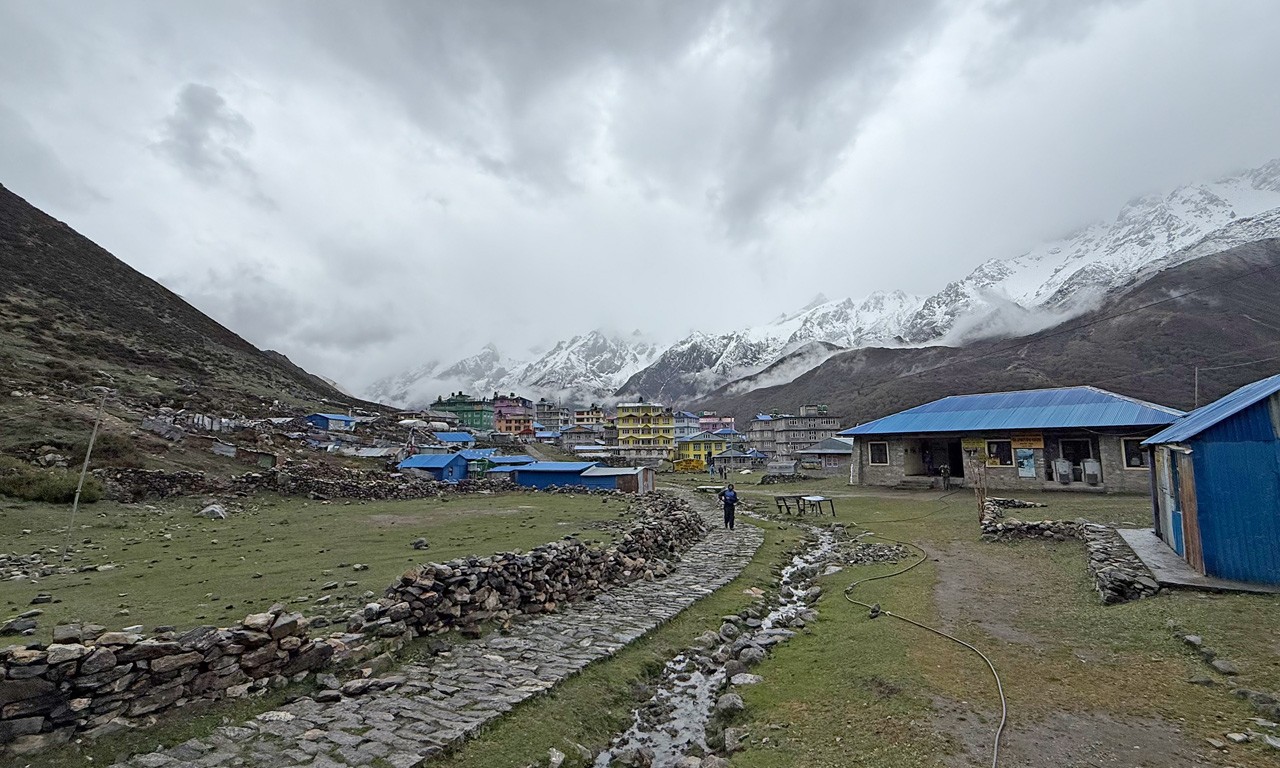
We stopped for lunch at the main Langtang Village. Seeing it today is deeply emotional. The 2015 earthquake completely erased the old village, and remembering the lives lost under that massive landslide makes your heart heavy. Yet, seeing Langtang rise from the rubble is nothing short of miraculous. Today, it features sturdy concrete buildings, modern rooms, and reliable hot showers.
However, despite the improved infrastructure, the quality of food in the Langtang region needs urgent improvement.
Compared to recently developed routes like the Manaslu Circuit Trek, where lodge owners serve exceptionally delicious and varied meals, Langtang falls short. Many domestic Nepalese trekkers were complaining about the food package deals. Even when paying a premium, they were often served a bare-minimum Dal Bhat consisting strictly of plain rice and watery lentil soup, completely lacking seasonal vegetables or side dishes. There is a clear lack of transparent communication between hotel owners and domestic guides.
- Pro Tip for Independent Trekkers: If you are booking budget or fixed packages, your meals will be very limited. We highly recommend packing plenty of your own high-energy snacks, trail mixes, and dried fruits.
Note: Since our trek coincided with the sacred Saga Dawa festival (the Tibetan Buddhist full moon celebration), meat was strictly banned across the valley, though eggs were still widely available.
We arrived at Kyanjin Gompa (3,807m) under a heavy, overcast sky. The wild wind was biting and hitting much harder than we anticipated for May. The valley was alive with the sounds of grazing yaks and the roaring river. The lodges were packed with local travelers—a great sign for the local economy, meaning lodge owners no longer have to shut down entirely during the shoulder seasons.
Days 3 & 4: Weather Demands and the Journey Home
On our third morning, we woke up hoping for a classic Himalayan sunrise. Unfortunately, the mountain weather had other plans. It had rained heavily all night and continued straight into the morning. We waited around, hoping for a window to scramble up Kyanjin Ri, but the fog never cleared.
Even without the viewpoint panoramic shots, the layout of the valley remained striking. We packed up and began our long retreat. To maximize our data collection on trail conditions, we hammered out a brutal 24 km descent, skipping Lama Hotel entirely to spend our final night at Sherpa Gaon.
Staying at Sherpa Gaon was a highlight. Unlike the high-altitude stops past Rimche where fresh produce is hard to come by, Sherpa Gaon features thriving local agriculture. We finally had a proper, nutritious Nepalese Dal Bhat made with fresh vegetables picked straight from the garden behind the lodge.
The next morning, the mountains gave us a parting gift. I looked out the back window and saw the Ganesh Himal range gleaming under a perfectly clear sky. Even though a small part of me felt a bit regretful that the weather hadn't cleared 24 hours earlier while we were at Kyanjin, that is the nature of the Himalayas.
We walked the final 5 km down to Srukha Village, caught our private jeep, and wrapped up our 96-hour "Fast & Furious" loop back to Kathmandu.
Insider Insight: Langtang Valley vs. Annapurna Base Camp (ABC)
If a traveler walks into the Rugged Trails Nepal office and asks me to choose between the Langtang Valley Trek and the Annapurna Base Camp Trek, from a photographic perspective and an experiential standpoint, I will choose Langtang every single time. While both routes are "in-and-out" trails (meaning you return the same way you walked in), Langtang possesses an authentic cultural soul that is becoming harder to find in the heavily commercialized Annapurna region.
| Feature | Langtang Valley Trek | Annapurna Base Camp (ABC) |
| Culture & Identity | Stronger, beautifully preserved Tibetan-Buddhist cultural identity and deep-rooted local history. | Highly commercialized, heavily westernized tea-house hub design. |
| Accommodations | Rebuilt modern concrete lodges dynamically mixed with authentic, deep local traditions and family vibes. | Highly standardized tourism menus with rigid corporate lodge regulations. |
| Scenery & Trails | Dramatic deep-valley topography offering spectacular, close-up glacier views right from the trail. | Classic amphitheater mountain views, but suffers from incredibly high foot traffic and crowded paths. |
The peaks will always be there, but the raw authenticity of the people is a fragile thing. Yes, the locals now own modern five-story concrete lodges, but they haven't abandoned who they are. You still see them waking up at dawn to perform their daily Buddhist rituals, spinning prayer wheels, and wearing their traditional attire. They have successfully blended modernization with cultural preservation.
For the true traveler, these massifs aren't just walls of rock and ice to photograph for social media; they are sacred landscapes tied to local faith. The valley is deeply blessed by histories of Guru Rinpoche. A trek here isn't just an exercise in altitude—it’s an immersion into culture, ancient lifestyle, alpine winds, and mountain spirituality.
Can You Do the Langtang Trek in 4 Days?
Final Verdict on Our Itinerary: Our 4-day round trip from Kathmandu is not recommended for average trekkers. We are professional mountain guides with decades of acclimatization and physical conditioning.
Skipping stops and gaining nearly 1,500 meters of elevation in a single day puts unconditioned hikers at an extreme risk for Acute Mountain Sickness (AMS). At 3,800 meters, the air is thin, headaches are common, and sleeping can be incredibly uncomfortable. For beginners and commercial clients, we strongly advise sticking to a classic 6 to 10-day Langtang itinerary, ensuring you spend a night adjusting at a lower altitude (like Langtang Village) before sleeping at Kyanjin Gompa.
Rugged Trails Nepal Langtang Valley Trek Package.
- Short Langtang Valley Trek (7 days)
- Langtang Valley Trek (10 days)